
Posture
What is poor posture, and can pilates improve it?
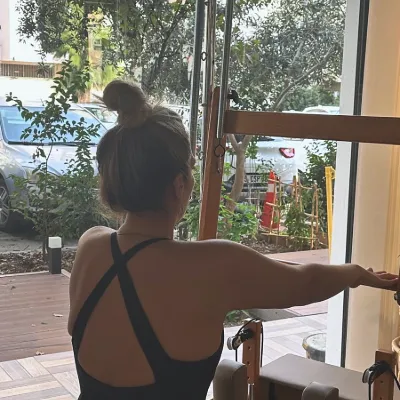
In short: Research suggests regular pilates can improve spinal curvature and general posture measures; two systematic reviews published in 2024 point in this direction. But there is no single "correct" posture, and the link between posture and pain is less clear than often assumed. The goal is not perfect posture but a strong, mobile body you can move comfortably through the day.
"Stand up straight", "don't slouch": we have all heard it. Many people who come to the studio tell us they want to improve their posture. So what exactly is poor posture, does it really cause problems, and what can pilates do about it? Here is what the research says, without exaggeration.
What is posture, and when is it "poor"?
Posture is the position your body takes when sitting, standing or moving. The spine has three natural curves: slightly inwards at the neck and lower back, slightly outwards at the upper back. When these curves increase or decrease markedly, or when the shoulders and head drift clearly forwards, people talk about "poor posture".
The most common patterns are:
- Rounded upper back (increased kyphosis): see our article on kyphosis.
- Forward head posture: the head sits in front of the shoulders, common in people who spend long hours at screens. See pilates for desk workers.
- Increased or flattened lower-back curve
- A sideways curve of the spine: this may be scoliosis and needs medical assessment.
Does bad posture really cause pain?
It is more complicated than it seems. A 2020 review of 41 systematic reviews found that sitting, bending or certain postures can be associated with low back pain, but there is no consensus that they cause it. A viewpoint written by physiotherapists also points out that the advice to "sit up straight" is not backed by strong evidence.
There is no single "right" posture. Your best posture is your next one: avoid staying in the same position for hours.
That does not make posture irrelevant. But aiming for a strong, flexible body that moves easily between positions is more realistic than aiming for "perfectly straight".
Can pilates improve posture? What the research says
In 2024 the same research team published two systematic reviews:
General posture
A review of 13 studies and 783 participants reported improvements in posture measures of the neck, upper back and lower back with pilates, along with benefits for pain and quality of life. About half of the studies were high quality.
Spinal curvature
A second review of 9 studies and 643 participants reported positive effects of pilates, or programmes combining pilates with other exercise, on spinal curvature and posture measures.
These results are encouraging, but most studies were small and short. Pilates is a sensible option for posture, not a miracle on its own.
How does pilates affect posture?
- Core and back muscles: it strengthens the muscles that support the spine. What is the core?
- Mobility: it includes stretches that improve movement in the upper back, hips and shoulders.
- Awareness: it teaches you to feel a neutral spine, and that awareness carries into daily life.
- Breathing: it trains rib-cage movement and breath control. How to breathe in pilates
What can you do during the day?
- Get up every 30–45 minutes, walk for a few minutes or change position.
- Bring your screen closer to eye level; lift the phone rather than dropping your head.
- Do muscle-strengthening exercise at least two days a week, as the World Health Organization recommends for all adults.
- Don't stiffen yourself trying to hold a "perfect" posture; stay relaxed and keep changing.
When to see a doctor: if your posture has changed noticeably in a short time, your shoulders or hips are clearly uneven, you have numbness or weakness, or pain that does not settle, see a doctor before starting exercise.
Posture work at Studio 4 Pilates
In your first class we look at your posture from the front, side and back together and talk about how you sit during the day. We then build your programme with equipment such as the Reformer, Cadillac reformer, Chair and Ladder Barrel. With no more than 3 people per class, every movement is closely followed. See all options on our classes page.
Frequently asked
How many weeks does it take pilates to improve posture?
There is no fixed answer. Programmes in research usually run 8–12 weeks with 2–3 sessions a week, and change varies from person to person.
Do posture braces work?
A brace can be a short-term reminder but does not strengthen muscles. Active exercise is the more sensible long-term approach; talk to your doctor if you are considering a brace.
Is reformer or mat better for posture?
Both can help. The reformer can support or challenge a movement with its springs, which may make it easier to feel good alignment when you start.
Sources
- Li F et al. Effects of Pilates on Body Posture: A Systematic Review. Archives of Rehabilitation Research and Clinical Translation, 2024
- Li F et al. Effects of Pilates exercises on spine deformities and posture: a systematic review. BMC Sports Sci Med Rehabil, 2024
- Swain CTV et al. No consensus on causality of spine postures or physical exposure and low back pain. Journal of Biomechanics, 2020
- Slater D et al. "Sit Up Straight": Time to Re-evaluate. JOSPT, 2019
- Bull FC et al. WHO 2020 guidelines on physical activity and sedentary behaviour. BJSM, 2020