
Posture
Pilates for desk workers: neck, shoulders and forward head posture
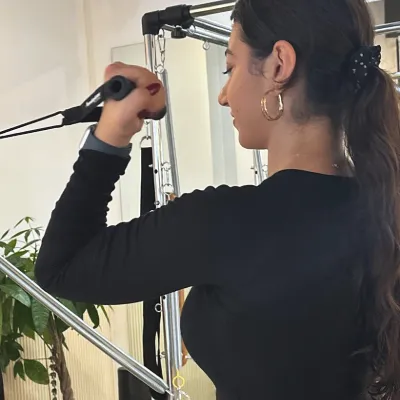
In short: Long hours looking at screens can make the head drift forward and leave the neck and shoulders tense. A meta-analysis found corrective exercise produced large improvements in forward head angle and moderate improvements in neck pain. Small pilates studies in office workers also report better posture and less neck pain. The most important step is still moving often during the day.
Starting the day at a computer and ending it on the phone is now routine for many of us. If your neck and shoulders feel loaded and your upper back stiff by evening, you are not alone. Here we cover posture for desk workers, the research, and the role of pilates.
What is forward head posture?
Seen from the side, the ear normally sits roughly above the shoulder. Leaning towards a screen for long periods can move the head in front of this line; this is forward head posture. It often comes with rounded shoulders and upper back. The muscles at the back of the neck and the shoulders then work harder, while the deep muscles at the front of the neck and those that draw the shoulder blades together may weaken.
Does exercise help?
Corrective exercise
A meta-analysis of 7 randomised trials and 627 participants found therapeutic exercise can produce large improvements in forward head angle and moderate improvements in neck pain. The authors note the link between posture and pain is not yet fully understood.
Pilates in office workers
In a 2025 study from Türkiye, 22 office workers did reformer pilates twice a week for 8 weeks, and their posture scores improved. A small randomised trial published in 2026 also found an 8-week pilates programme improved neck pain, disability and neck range of motion.
These pilates studies are small and some had no comparison group, but the results point in the same direction as the broader exercise research.
What does pilates offer office workers?
- Deep neck muscles: small movements that stack the head over the spine train the deep neck muscles.
- Shoulder blades and upper back: spring arm work on the tower and strap exercises strengthen the muscles that draw the shoulders back.
- Chest opening: stretches the closed-in chest and mobilises the upper back.
- Core: strengthens the muscles that support the spine while you sit.
Even the best ergonomics cannot replace moving regularly.
Practical tips at your desk
- Screen: top edge at or slightly below eye level, about an arm's length away.
- Laptop: for long sessions, use a separate keyboard and a stand.
- Breaks: get up every 30–45 minutes; roll your shoulders back a few times and turn your head slowly side to side.
- Phone: lift the phone to eye level instead of dropping your head.
- Weekly activity: the World Health Organization recommends reducing sitting time and doing muscle-strengthening activity at least two days a week.
When to see a doctor: if you have pain spreading into the arms, numbness, tingling or weakness, severe headaches or neck pain that does not settle, see a doctor before exercising.
For office workers at Studio 4 Pilates
We teach 08:00–20:00 on weekdays and 08:00–13:00 at weekends, so it is easy to fit a class before or after work. In the first class we talk about how you sit and where you struggle during the day, and build your programme around that. For research on back and neck pain, see this article.
Frequently asked
How many days a week should I do pilates if I work at a desk?
Research programmes usually involve 2–3 sessions a week. Two classes a week is a good start; breaks during the day matter just as much.
Is pilates good for a cervical disc herniation?
It depends on your condition and your doctor's advice. With medical approval, pilates can be done with a programme adapted to you; share your diagnosis with your instructor.
Is there a short exercise I can do at the office?
Drawing the shoulders back and down for a few breaths, gently gliding the head back with a slight chin tuck, and a short walk are good places to start.
Sources
- Sheikhhoseini R et al. Effectiveness of Therapeutic Exercise on Forward Head Posture: A Systematic Review and Meta-analysis. J Manipulative Physiol Ther, 2018
- Taştan Z et al. The effects of reformer pilates on postural alignment, body appreciation and social appearance anxiety in office workers. BMC Sports Sci Med Rehabil, 2025
- Göz A, Mutlu A, Göz E. Pilates and Kinesiotaping for Neck Pain, Disability and Cervical Function in Office Workers: A Randomised Controlled Trial. Pain Res Manag, 2026
- Bull FC et al. WHO 2020 guidelines on physical activity and sedentary behaviour. BJSM, 2020