
Getting started
Reformer or mat pilates? The differences and which one suits you
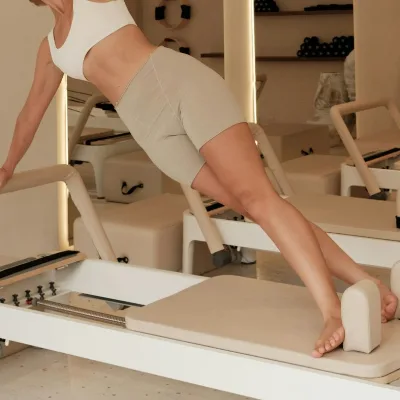
In short: Both are based on the same pilates principles. The reformer provides resistance and support through springs; the mat uses only your body weight and demands more muscle control. For beginners the reformer is often an easier way in; the best results usually come from doing both.
What they have in common
Pilates is an exercise method developed by Joseph Pilates in the early 20th century; he called it "Contrology". Both mat and reformer work rest on the same foundations: controlled movement, breathing, core strength (abdomen, back, hips) and correct alignment.
What is reformer pilates?
The reformer is a pilates machine made up of a sliding platform, a footbar and springs of different tensions. The springs can be used as resistance to make a movement harder, or to support the body at a challenging point. Hundreds of different movements can be done on the same machine lying down, sitting, kneeling and standing.
What is mat pilates?
Mat pilates is done on a mat. Your own body weight is the source of resistance, and small equipment such as a ball, resistance band or pilates ring can be added. Because no machine carries you, you manage every movement with your own muscle control.
Parts of the reformer
The reformer can look complicated at first, but the logic is simple: you lie, sit or kneel on the sliding platform and move it by pressing the footbar with your feet or the straps with your hands. As the number and tension of the springs change, the movement becomes harder or easier.
What equipment is used in a mat class?
Pilates ball
A small, soft ball. Placed between the legs or under the back, it increases balance and muscle activation.
Resistance band
An elastic band. It adds light resistance to arm and leg movements and supports stretches.
Pilates ring
A flexible ring. When squeezed, it works the inner thigh, arm and chest muscles.
Foam roller
A cylinder that can be used for balance work and for releasing after exercise.
Comparison
| Reformer | Mat | |
|---|---|---|
| Resistance | Adjustable springs | Body weight, small equipment |
| For beginners | Usually an easier start, as the springs give support | Basic movements look simple but demand control |
| Variety | A great many positions and movements | Flow-focused, varied with equipment |
| Practising at home | Requires a machine | Can be done at home |
| At Studio 4 | Private, duo or trio | Private, duo or trio |
Which should I start with?
- If you've never done pilates: Starting with a private Reformer class lets you learn the movements with support.
- If you also want to work out at home: Mat classes make it easier to repeat what you learn at home.
- If you want to progress faster: Alternating between the two builds both strength and control.
- If you have a health condition: Check with your doctor first, then start with a private class.
At Studio 4 Pilates we teach both classes with no more than 3 people. If you're not sure which suits you, you can try both in your first class. You can see the class formats on our Reformer Pilates and Mat Pilates pages.
Frequently asked
Is reformer pilates more effective than mat pilates?
Neither is definitively more effective than the other. The reformer makes it easier to adjust resistance; the mat challenges muscle control more. The most effective class is the one you do regularly and that suits your level.
Can a beginner go straight to the reformer?
Yes, with an instructor. Because the springs can be set to support the movement, the reformer is suitable for beginners.
Is reformer pilates painful or hard?
With correctly set springs, reformer movements can be supported, so it is usually a comfortable start for beginners. The level of difficulty is adjusted through the springs and the choice of movements.
Can I do mat pilates at home?
Yes, you can repeat the basic movements you learn on the mat at home. Learning the movements correctly with an instructor first prevents repeating them incorrectly at home.